The Fluid Power of Rubber Production: Process Oils and Plasticizers
30.08.2026Process oils and plasticizers are an indispensable part of production formulations to improve the processability of rubber compounds, balance their flexibility, and optimize production costs. These components reduce friction by penetrating between polymer chains, ensure that fillers (such as carbon black) to disperse flawlessly within the compound, and improve the final product’s cold-weather resistance. We can classify these components—which directly affect the quality of the product as it exits the production line—into four main groups:
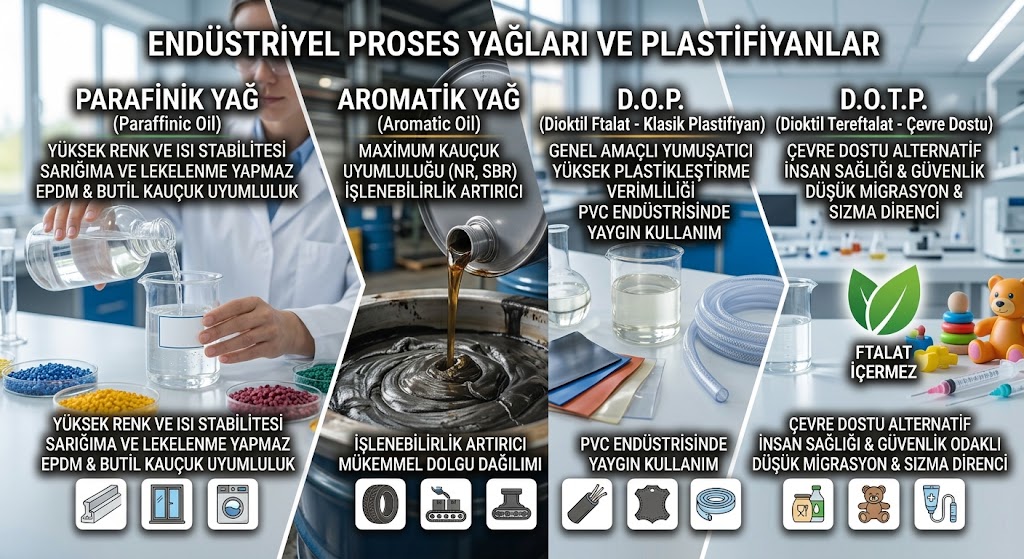
Paraffinic Oil: Color Stability and Low Staining
(Visual Suggestion: A bright composition highlighting the pure and clear structure of paraffinic oil—which is either completely transparent or very light yellow in color—resting in a glass beaker in a laboratory setting.)
Paraffinic oils, which consist of branched alkane chains, are particularly preferred in the production of light-colored or colored rubber products. Due to their chemical structure, they are resistant to oxidation and do not yellow or stain when exposed to sunlight. They are perfectly compatible with EPDM and butyl (IIR) rubber types.
- Key Features: High heat and color stability, low volatility, non-staining (non-staining) formulation.
- Applications: Light-colored automotive seals, window gaskets, home appliance components, and colorful toys.
Aromatic Oil: High Performance and Perfect Compatibility
(Visual Suggestion: A close-up shot showing the aromatic oil—dark in color and thick in consistency— , conveying the material’s industrial and robust nature.)
Aromatic oils containing carbon rings exhibit the highest chemical compatibility, particularly with Natural Rubber (NR), Styrene-Butadiene (SBR), and Polybutadiene (BR). They significantly improve the compound’s processability but are used only in black products due to their dark color and tendency to cause staining."
- Key Features: Maximum compatibility with polymers, high flexibility, cost advantage, and good dispersion .
- Applications: Automotive and construction equipment tires, black conveyor belts, heavy-duty industrial hoses, and shims.
D.O.P. (Dioctyl Phthalate): A Traditional and Effective Plasticizer
(Visual Suggestion: An industrial image depicting the moment when transparent D.O.P. liquid is mixed with flexible PVC or rubber granules, referencing the material’s plasticizing effect.)
It is a phthalate-based general-purpose plasticizer that is widely known in the industry and has been in widespread use for many years. It imparts excellent softness and elongation at break to the material, both in specialty rubbers such as NBR (Nitrile) and CR (Neoprene) as well as in the PVC industry, it imparts excellent softness and elongation at break to the material.
- Key Features: High plasticization efficiency, water resistance, good electrical insulation, and cost-effectiveness.
- Applications: Cable sheaths, artificial leather, flexible hoses, floor coverings, and general-purpose rubber/PVC gaskets.
D.O.T.P. (Dioctyl Terephthalate): An Eco-Friendly and Reliable Alternative
(Visual Suggestion: A clean environment in the background symbolizing medical or food compliance, featuring a green leaf iconor a transparent D.O.T.P. liquid presented alongside an "Eco-Friendly" highlight.)
D.O.P., while offering the same physical advantages, is a new-generation plasticizer classified as “phthalate-free” due to differences in its molecular structure. Due to increasingly strict regulations regarding the environment and human health (e.g., REACH), phthalate-based products.
- Key Features: Non-carcinogenic and non-toxic, low cold brittleness, high resistance to leaching (migration) from plastisol.
- Applications: Hoses that come into contact with food, toys, medical products, interior flooring, and all rubber/PVC applications where human health is a top priority.