The Factors That Determine the Properties of Rubber: Fillers and Additives
30.08.2026The key elements that transform raw rubber from merely a flexible material into a wear-resistant industrial machine tire, a pressure-resistant sealing element, or a bright white medical gasket are the fillers and additives incorporated into the formula. In industrial production, these critical components—which enhance mechanical strength (reinforcement), determine color, add volume, and optimize costs—can be categorized into four main groups:
Silica (SiO₂): TearResistance and Color Production
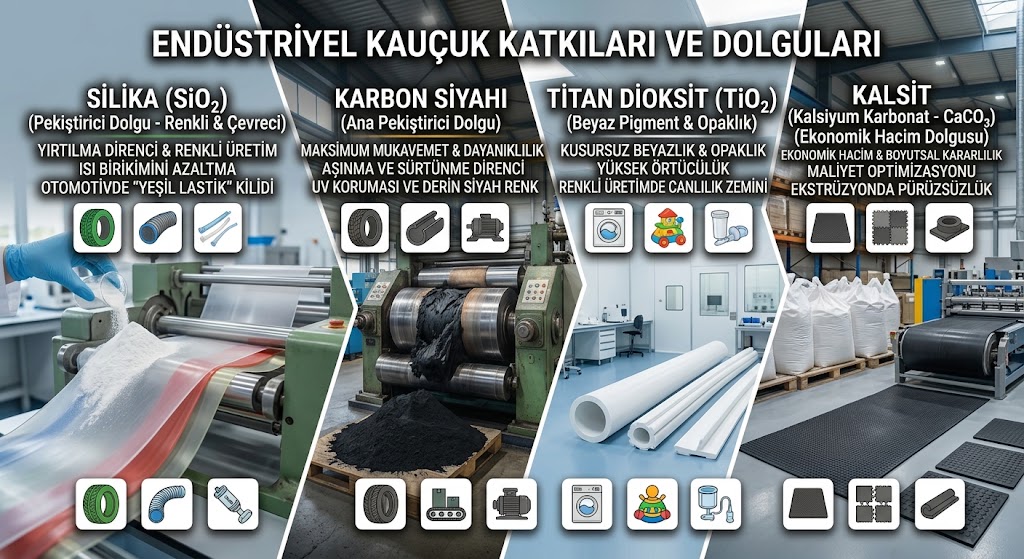
(Visual Suggestion: A photo showing the process of mixing silica—which appears as a fine, white powder in a laboratory setting—into a light-colored or transparent rubber compound, emphasizing cleanliness and high technology.)
In the rubber industry, it is the most commonly used reinforcing filler after carbon black. It replaces carbon black, particularly when producing colored, semi-transparent, or transparent rubber products. It plays a key role in the production of tires known as “green tires” in the automotive industry—tires that offer low rolling resistance and improve fuel efficiency.
- Key Features: Provides high tear and tensile strength, reduces heat buildup, and increases the rubber’s resistance without compromising its flexibility.
- Applications: Colored shoe soles, fuel-efficient car tires, transparent hoses, medical silicone parts, and cable insulation.
Carbon Black: Maximum Strength and Durability
(Visual Suggestion: An industrial moment where fine, jet-black, and dense carbon black powder blends with raw rubber in a heavy-duty industrial mixer, imparting its characteristic black color and matte, robust texture.)
It is undoubtedly the most important and most widely used reinforcing filler in the rubber industry. It elevates the material’s resistance to wear, tear, and friction to extraordinary levels. At the same time, by absorbing UV rays, it perfectly protects the rubber against the sun’s aging effects and gives the material its characteristic deep black color.
- Key Features: Maximum abrasion resistance, high tensile strength, electrical conductivity (or insulation, depending on the type), and strong UV protection.
- Applications: Heavy-duty and passenger vehicle tires, industrial conveyor belts, pressure-resistant black hoses, engine mounts, and sealing gaskets.
Titanium Dioxide (TiO₂): Perfect Whiteness and Opacity
(Visual Suggestion: A bright and sterile composition featuring white rubber profiles or white appliance gaskets with an aesthetic, smooth surface that stands out for its brilliant whiteness.)
It is the most powerful white pigment used in the rubber and plastics industry. It not only imparts a flawless whiteness to products but also provides high opacity (opacity), completely concealing the color of the underlying compound. In the production of colored rubber, it serves as a base to bring out the vibrancy of other color pigments.
- Key Features: Excellent whitening power, high UV reflectivity, chemical inertness (non-reactive), and color stability.
- Applications: Rubber bellows and gaskets for home appliances, decorative floor coverings, colorful toys, medical products, and rubber components for the marine industry.
Calcite (Calcium Carbonate - CaCO₃): Economic Volume and Dimensional Stability
(Visual Suggestion: A production facility where micronized, homogeneous calcite powder is transferred from sacks to the production line, with wide rubber floor coverings or mats made from this filler visible in the background.)
It is a non-reinforcing filler material obtained by micronizing marble or limestone, which are abundant in nature. It significantly reduces production costs significantly. It also prevents the material from shrinking dimensionally after vulcanization.
- Key Features: Significant cost savings, ensuring the dough emerges smoothly from the extruder, dimensional stability, and low oil absorption.
- Applications: Automotive floor mats, rubber floor tiles, low-pressure hoses, sponge gaskets, and general-purpose, cost-effective rubber parts.
The type and micron size of the filler used in the formulation directly determine the quality standards of the industry in which the rubber will be used. With the right combination of additives, it is possible to produce high-performance products that meet engineering requirements while also being commercially competitive.