The Unsung Heroes of Rubber: Chemicals That Make a Difference in Production
30.08.2026The transformation of rubber compound into a flexible and durable final product capable of withstanding harsh industrial conditions is made possible not only by the primary raw material but also by the precise balance of chemicals added to the formulation. The fundamental rubberrubber chemicals that optimize the production process, manage costs, and determine the quality of the final product are grouped into four main categories:
Accelerators (Accelerators): Saving Time and Energy
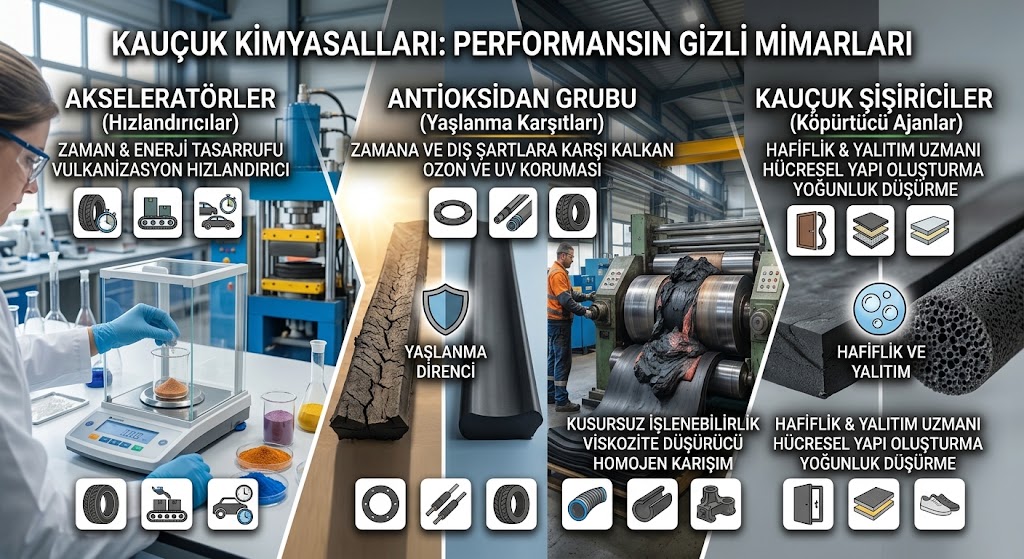
(Visual Suggestion: A modern composition reflecting speed and productivity, featuring colored chemicals weighed on a precision balance in a laboratory setting, with an industrial vulcanization press operating in the background—a modern composition reflecting speed and productivity.)
These are the most critical reactants in the sulfur-based vulcanization (curing) process. They maximize the efficiency of production lines by shortening the reaction time and lowering the required curing temperature.
- Key Features: Accelerates cross-linking between polymer chains, reduces energy costs, and increases the rubber’s mechanical strength (tear and tensile strength).
- Intended Use: To increase production capacity, optimize mold cycle times, and achieve standard mechanical properties.
Antioxidant Group: A Shield Against Time and Environmental Conditions
(Visual Suggestion: A close-up of a rubber profile—one side exposed to harsh weather conditions (intense UV light, ozone) and beginning to crack, while the other side, thanks to antioxidant protection that retains its smoothness from the very first day.)
Rubber products age over timeage, crack, or harden when exposed to external factors such as heat, light, oxygen, and ozone. Antioxidants and antiozonants are chemical shields that slow down this degradation process by trapping free radicals.
- Key Features: Prevents molecular chains from breaking, preserves the material’s flexibility, and maximizes fatigue resistance.
- Intended Use: To extend the service life of products operating under demanding conditions, such as automotive parts, outdoor gaskets, conveyor belts, andcovers—that operate under harsh conditions.
Process Auxiliary Chemicals: Flawless Processability
(Visual Suggestion: A smooth, high-surface-quality, homogeneous black rubber compound flowing seamlessly from an open-roll (two-roll mill) or an extrusion line, highlighting the fluidity of a homogeneous black rubber compound with high surface quality.)
Rubber is used to overcome the physical challenges encountered during the mixing, extrusion, and molding of rubber compound. This group includes dispersing agents that ensure the homogeneous distribution of carbon black and other fillers within the mixture, as well as mold release agents and special lubricants.
- Key Features: It reduces the dough’s viscosity (resistance to flow) , prevents sticking to the mold, and minimizes machine wear.
- Purpose: To reduce production scrap, facilitate the demolding process, and produce parts with flawless surface quality.
Rubber Expanders (Foaming Agents): Experts in Lightweight Design and Insulation
(Image Suggestion: A close-up showing the different cross-sections of a sponge—with its microscopically porous cellular structure clearly visible—alongside standard-density solid rubber showing different cross-sections of the wicks.)
These are chemicals that, when a certain temperature is reached, release gases such as nitrogen or carbon dioxide, forming closed or open air cells within the rubber compound. This reaction while significantly reducing its specific gravity.
- Key Features: It gives the material a spongy texture, reduces its density, and provides excellent resilience (elasticity).
- Intended Use: To produce automotive door seals, insulation panels, vibration-damping pads, and lightweight shoe soles that require sound, thermal, dust, and liquid insulation.