The Industry’s Flexible Power: A Detailed Look at Rubber Compounds
30.08.2026The Industry’s Flexible Power: A Detailed Look at Rubber Groups
In modern industry, when it comes to durability, flexibility, and insulation, the first material that comes to mind is undoubtedly rubber. Used in thousands of different fields—from the automotive industry to healthcare, from construction to everyday consumer products—rubber is manufactured in specific forms depending on its intended use. Let’s take a closer look at the three main rubber groups most frequently chosen to optimize production processes and ensure the right material selection: reclaimed rubber, rubber compound, and silicone rubber.
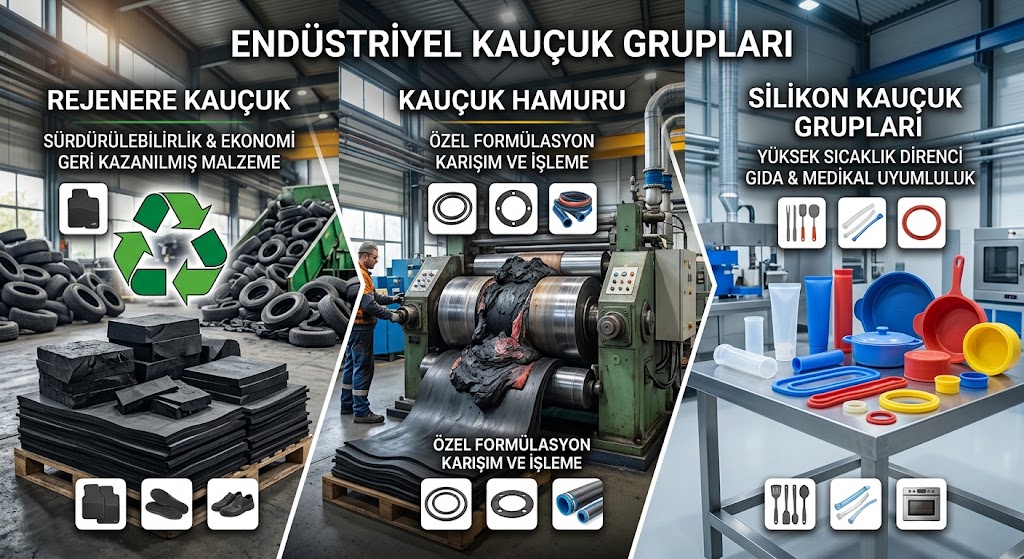
Recycled Rubber: A Sustainable and Economical Solution
(Visual Suggestion: A composition highlighting recycling and the industrial cycle, featuring end-of-life automobile tires in the background and processed, ready-to-use black regenerated rubber sheets in the foreground.)
Reclaimed rubber is obtained by subjecting end-of-life tires and other rubber waste to various mechanical, thermal, and chemical processes to make them reusable. This recovery process not only significantly reduces production costs but also makes a major contribution to environmental sustainability.
- Key Features: When added to new rubber compounds, it shortens mixing times, saves energy during the vulcanization stage, and improves flow during molding.
- Applications: Shoe soles, automotive floor mats, conveyor belts, bicycle tires, floor coverings, and vibration-damping mounts.
Rubber Compound: Formulated Production Power
(Visual Suggestion: A close-up industrial shot capturing the texture of a smooth, homogeneous rubber compound—processed in an open Banbury or two-roll mill—as it passes between the rollers.)
Rubber compound (or compound), is a mixture of raw rubber blended with carbon black, sulfur, accelerators, oils, and various anti-aging agents according to a specific formula prior to vulcanization. It is specially formulated based on the mechanical strength, hardness, chemical resistance, and elongation at break.
- Key Features: It has a fully customizable structure based on desired physical and chemical properties. It is a semi-finished product ready for direct use in compression molding or extrusion lines.
- Applications: Sealing elements (O-rings, gaskets), automotive replacement parts, custom-made hoses, construction machinery components, and industrial molded parts.
Silicone Rubber Groups: An Innovative Material for Harsh Conditions
(Visual Suggestion: Clean, bright studio lighting; semi-transparent silicone rubber rolls or gaskets in various vivid colors such as transparent, blue, and red.)
Unlike carbon-based standard rubbers, silicone rubbers—which have a silicon and oxygen backbone—are designed for extreme conditions. Their ability to maintain their elasticity and structure makes this group indispensable for high-tech applications and precision industries.
- Key Features: Wide operating temperature range (between -60°C and +250°C), high UV and ozone resistance, biocompatibility, and an odorless/tasteless composition.
- Applications: Medical device parts and tubing, baby pacifiers, kitchen utensils that come into contact with food, oven gaskets, sealing elements for the aerospace industry, and high-voltage insulators.
Each rubber group offers its own unique advantages. In cost-effective and environmentally friendly projects, recycled rubber is specially formulated rubber compounds should be used for industrial parts requiring specific mechanical strength, and silicone rubbers should be preferred in situations involving extreme temperatures and strict hygiene standards. The material selection you make after accurately analyzing your project’s technical and budgetary requirements will directly determine the final product’s market success and service life.